
WordPress.org's plugin rankings work in two stages - a query first has to match a plugin's title, description, and tags as an exact phrase, and then a separate set of factors decides where that plugin lands among everyone else who also matched. That second stage weighs support ticket resolution rate, update recency, and rating trend heavily, with active installs mattering only up to a ceiling.
The two stages don't blend into each other. A plugin can match perfectly and still rank low; a plugin with a middling title can still rank well once it matches, if the second-stage factors are strong. I've picked up on this before: confusing the two is the most common mistake in how people think about this algorithm - it leads people to keep rewriting a readme that already matches fine, when the actual problem is a resolution rate or an update history that stage two is quietly penalizing instead.
Stage one: you have to match before anything else counts
The algorithm checks a query against the title, excerpt, description, slug, tags, and author or contributor names, looking for the phrase to appear somewhere - not scattered as related individual words. The title carries the most weight in this stage, according to Freemius's analysis of the plugin directory's search algorithm. Since the title, description, and tags all live in the same readme file, it's worth confirming they actually say what you think before you publish - see how to check your WordPress plugin readme before publishing.
Matching is binary, not graded. A plugin either has the phrase somewhere in the checked fields, or it doesn't show up for that query at all - there's no partial credit for a near-miss synonym, which is why exact phrasing in the title and description matters more here than it does almost anywhere else in the algorithm.
Stage two: what decides who wins once everyone matches
Once a plugin matches, several things weigh on where it lands, and not all of them are equally visible to plugin authors:
Support ticket resolution rate. Explicitly part of the calculation - a new plugin with no history defaults to 50%, and resolving threads promptly moves that number fast.
Update recency. There's roughly a 180-day window - go quiet past that and it starts costing rank.
Rating trend. A plugin with no reviews defaults to a 2.5-star rating rather than zero; from there, Freemius's analysis describes rating as having an outsized effect on stage-two ranking, larger than active install count for most plugins.
Active installs, but with a ceiling. Plugins over roughly 1,000,000 active installs get the maximum available boost from this factor; everyone else competes on relative counts below it.
WordPress core compatibility. Whether your "Tested up to" version is current is checked alongside recency - a plugin that ships updates but never bumps this line isn't getting full credit for looking current.
I've found resolution rate and rating trend are the two factors doing the most work for a typical mid-size plugin, precisely because they're not capped by a ceiling the way install count is.
Why the install ceiling matters more than you'd guess
An earlier post in this series put the directory-wide count of actively maintained plugins at roughly 26,770 out of 65,282 listed - and only a small fraction of even that group will ever cross a million installs. This is the factor set I point most plugin authors toward: for nearly everyone in the directory, resolution rate, freshness, and rating are what you can actually move, because the install-count ceiling simply isn't reachable for most plugins regardless of how good they are.
A caveat: the exact weighting isn't public
WordPress.org hasn't published an exact weighting formula for any of this - the picture above comes from community analysis of the algorithm's observed behavior, not an official specification. I lean toward seeing the direction of each factor as reliable and the precise weighting as an estimate, and I'd treat any two numbers you see cited elsewhere with slightly different exact figures as reasonable, not contradictory - they're estimates of the same underlying, unpublished system.
Where to actually spend your effort
Match first, using exact keyword phrases in the title and description. Then work the factors available to every plugin regardless of install count - resolution rate, update cadence, and rating trend - since the install-based factor simply isn't reachable for most plugins in the directory. Our guide to improving search visibility walks through all four levers in practice, including which one to work on first.
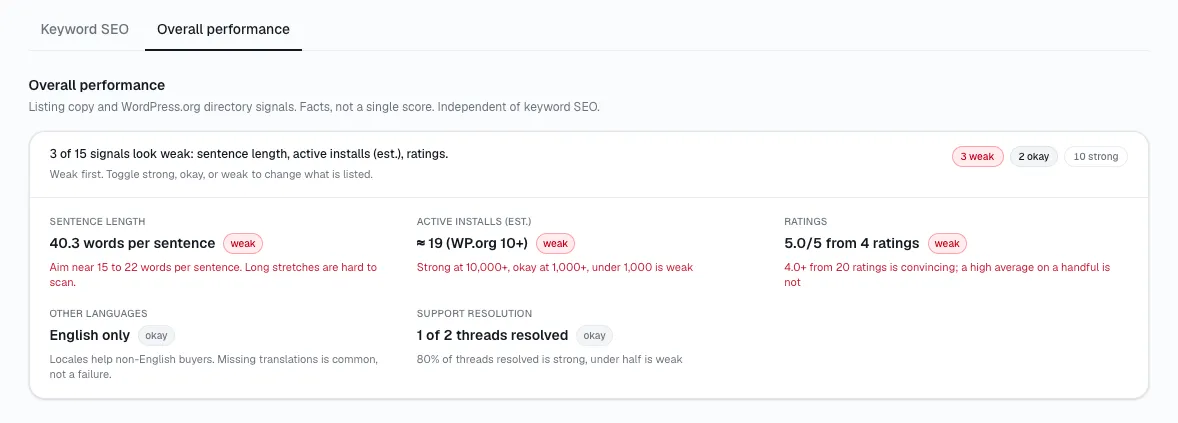
I've checked this by hand before, and it means reading your own support forum, checking a calendar, and re-adding up your reviews. StatWP's growth tracker rolls resolution rate, freshness, and rating into a single search visibility and trust score for both plugins and themes instead - faster than estimating the algorithm's likely weighting from a live search result yourself.
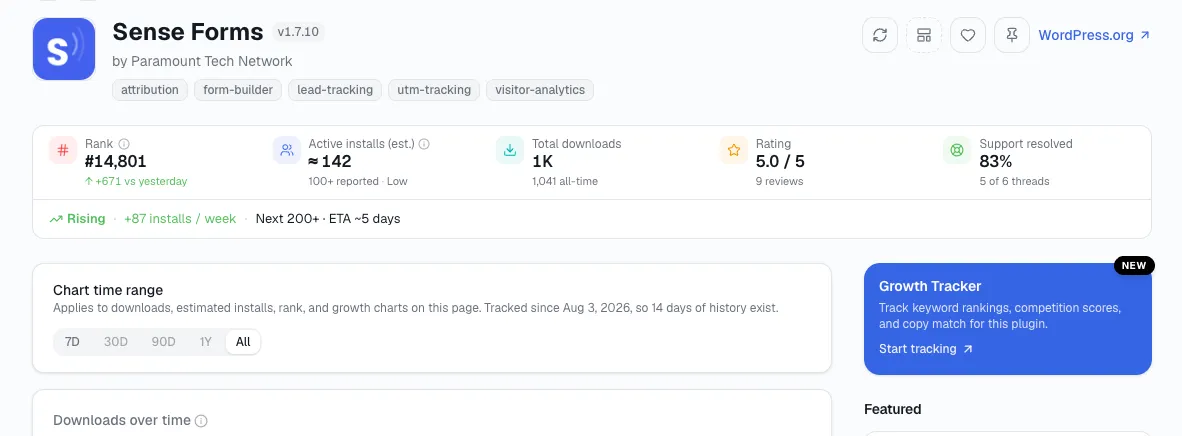
Installs and rank on the same card
Once you know installs stop moving rank past the roughly-million ceiling, I gauge seeing both numbers side by side as mostly a sanity check rather than a lever to pull - the same card exists whether you maintain a plugin or a theme.
For a habit of watching that score - and your keyword rank - move over time, see how to track your WordPress plugin's WordPress.org SEO rankings.
What the algorithm still leaves you wondering
Is this the same algorithm that ranks WordPress.org search results and the "Popular" or "Featured" plugin lists?
No - those are curated or sorted by different criteria entirely, not by the search-matching algorithm described here. This explainer is specifically about what happens when someone types a search query into the plugin directory's search box.
If I match perfectly on stage one, am I guaranteed a top result?
No. Matching only gets you into the set of results being ranked - stage two then sorts everyone who matched, and a plugin with a weaker resolution rate or a stale update history can still land below a plugin with a less perfect keyword match but stronger fundamentals.
Does WordPress.org ever publish updates to how this works?
Not in detail. Individual policy changes, like the tag-count guidance, do get announced on the official plugins blog, but the actual ranking weights have never been published as a specification - everything about stage two is inferred from observed behavior, not an official document.
Is a brand-new plugin with zero history at a permanent disadvantage?
Not permanent, but real at first - the 50% resolution-rate default and 2.5-star rating default both sit below where an established, well-run plugin ends up, and installs obviously start at zero. All three of those move quickly with real activity though - I'd read a slow start that way rather than assume the algorithm is simply against new plugins.
Where do I actually go to apply all of this?
Our guide to improving search visibility turns this explainer into an action list. This post explains how the algorithm behaves; that one covers what to actually go do about it.
Does this algorithm have anything to do with how my plugin ranks on Google?
No - they're entirely separate systems with separate indexes. Optimizing your readme for WordPress.org's search algorithm does nothing for how your plugin's own website or landing page ranks in Google, and vice versa.