
A WordPress plugin niche is saturated when three numbers line up at once: a high share of installs concentrated in the top three listings, a high share of those listings still actively maintained, and a solid median rating across the category. A large listing count on its own says nothing about whether the demand is actually spoken for. I use the same three-number check for a theme niche just as often as a plugin one - the logic doesn't change.
This is the diagnosis. If your niche does come back saturated, the next question - what to actually do about it - is a separate step, covered in how to find opportunities in a crowded WordPress plugin market. Read this one first.
Check the Three Saturation Numbers
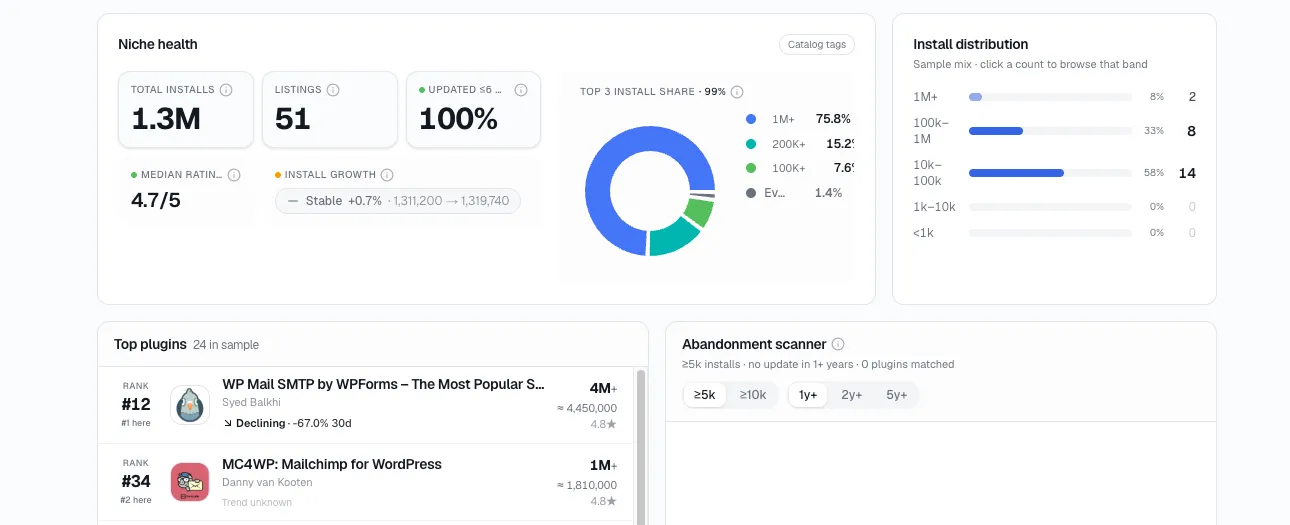
What it comes down to: A WordPress plugin niche is saturated when three numbers line up at once: high install concentration in the top three listings, a high share of those listings still actively maintained, and a solid median rating across the category.
Four things people get wrong about saturation
Myth: a big listing count means the niche is saturated.
Reality: twenty listings in a niche can mean two very different things. If three of them are actively maintained, growing, and holding most of the installs, and the other seventeen are stale, the niche behaves like it has three real competitors, not twenty - saturated by the three, not the twenty. If installs are spread more evenly and most listings are still maintained, twenty active, healthy competitors is a genuinely different, harder market than three. On its own, I don't trust the count to tell me which situation I'm looking at.
Myth: high install concentration always means saturated.
Reality: concentration is only one of the three numbers. A niche where the top three hold most of the installs but are themselves stale and unmaintained isn't saturated - it's abandoned, and abandoned is a different opportunity entirely, covered in our guide on finding abandoned plugins. Saturation assumes the competition is alive; a high concentration ratio among dead listings is a completely different finding.
Myth: a saturated niche is never worth entering.
Reality: saturation and "not worth entering" aren't the same call. A niche that scores high on concentration and maintenance but only middling on median rating is telling you something specific - users are stuck with what's available, not satisfied by it. I still treat that as a real opening, just a different kind of one than an open niche offers.
Myth: once saturated, always saturated.
Reality: all three numbers move. A leading plugin can go quiet, a median rating can slip after a bad update cycle, or concentration can loosen as a new entrant takes share. A niche scored as saturated today is worth a re-check later, not a permanent write-off - this is roughly what I expect: a point-in-time read, not a fixed label.
Myth: a niche that passes the room-to-grow screen can't also be saturated.
Reality: the two checks measure different things at different moments. A niche can show a low concentration ratio today and still be trending toward saturation if its maintained share and rating are both falling - the room-to-grow screen is a snapshot, and saturation is closer to a trajectory. I run both, and re-run them periodically, since that's what catches a niche mid-transition instead of only at the extremes.
The three numbers that actually decide it
Top-3 install share is high. When a small number of listings hold most of a niche's installs, whatever demand exists has already found its answer - a new entrant is competing against plugins that already have those users, not filling a gap.
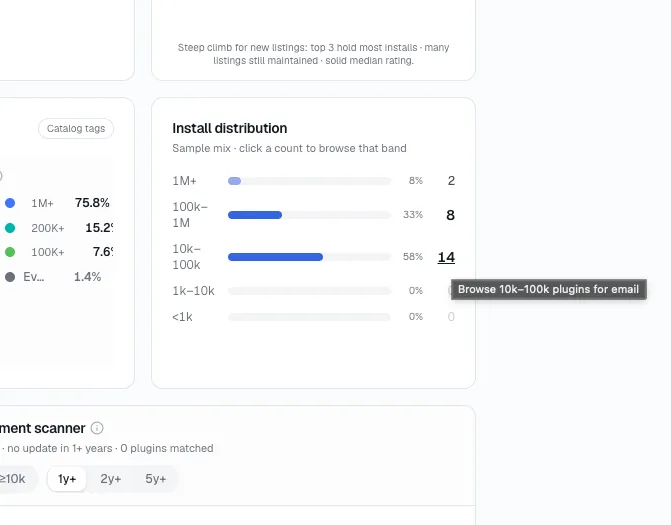
A high share of listings are actively maintained. Saturation assumes the competition is alive, not just that installs are locked up. Check what share of the niche - not just the top three - shipped an update in roughly the last six months.
Median rating holds up. A saturated niche where the leading plugins are also well-rated is a genuinely hard market to enter head-on. A saturated niche with a mediocre median rating despite high concentration is a different, more workable situation - users are stuck with what's available, not satisfied by it.
A narrower test than the full health check
These three numbers are a subset of a bigger picture, deliberately. Analyzing a niche's full health looks at all seven numbers - including total install scale and listing count - to judge whether a niche is worth entering at all. This saturation check is narrower on purpose: it answers one specific question (is the existing competition alive, dominant, and satisfying users), not the whole build-or-don't-build decision. Run the full health check once saturation alone doesn't settle it.
It's also a different test from the room-to-grow screen, which uses concentration ratio as a single signal alongside growth, listing count, and maintenance. Saturation combines concentration with maintenance and rating specifically to answer a sharper question: not just "is there room," but "is the room that exists actually worth fighting for."
Skip the tab-hopping - see all three in one place
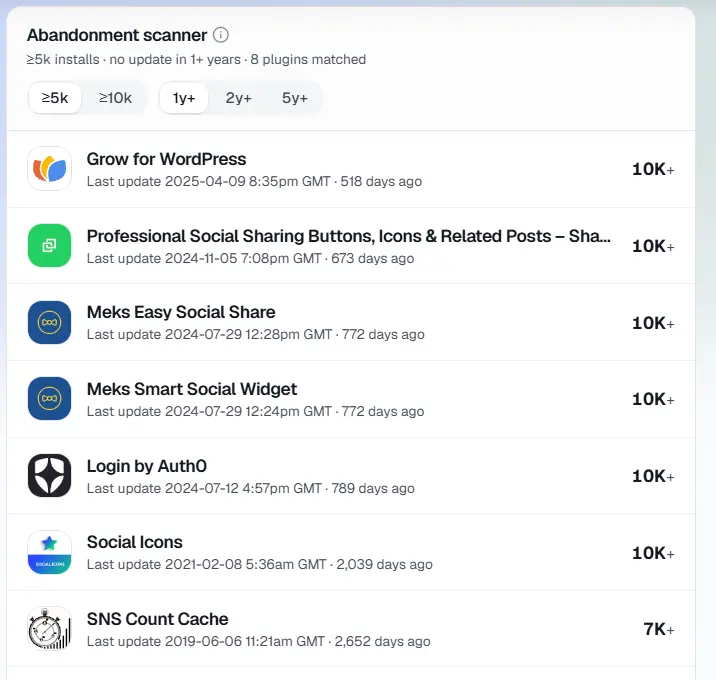
The abandonment scanner - one of the three numbers behind the saturation call, matched against real last-update dates.
Open statwp.com/tools/niche, pick your plugin or theme niche, and look at the Niche health panel - it puts all three numbers in front of you at once, so checking the combination stops being a five-tab exercise:
Top-3 install share
Share of listings updated in the last six months
Median rating
I've learned a niche that scores high on concentration and maintenance but only middling on rating is the one worth a second look, not the one to write off. If all three come back high, that's the genuinely saturated case - and the next step from there is working out what to do about a crowded market rather than walking away.
Test Your Niche for Saturation
Saturation questions worth settling first
What counts as "high" for these three numbers?
There's no fixed universal cutoff, in my experience - I judge each number relative to the niche's size and to comparable niches I've already checked. The combination matters more than any single threshold: all three trending high together is the strong signal, not any one crossing an arbitrary line alone.
Can a niche be saturated in one sub-category and open in another?
Yes, and it's common. A broad tag can score as saturated overall while a specific sub-niche inside it is nearly empty - the full niche-research process's sub-niche step is where that split gets caught, since the three-number check here works at whatever boundary you've drawn.
Is a saturated niche ever the wrong niche to walk away from?
Sometimes I think the honest call is to walk away - a saturated niche with a high median rating and no maintenance gaps is a genuinely hard market. But saturated isn't automatically a dead end; check the rating number specifically before deciding, since a mediocre rating inside a saturated niche is exactly the case worth a second look.
How is this different from checking if a niche is abandoned?
Saturation assumes the top listings are alive and actively competing. If the maintained-share number is low even among the top three, that's not saturation - it's an abandonment situation, and it calls for a different response.
Should I run the saturation check before or after the room-to-grow screen?
Either order works, but I run both on the same shortlist rather than picking one, because that's what actually catches the trickier cases - a niche that clears one and not the other is exactly the kind of result worth a closer look, not a tie-breaker to ignore.