
Benchmarking your WordPress plugin against competitors (or your theme, against theirs) means running your own plugin through the identical 11-signal scorecard you'd use on any of them, pulled on the same day, side by side - not comparing your plugin's current numbers against a competitor snapshot you checked weeks ago. This only works against competitors you're already watching regularly - see how to track your WordPress plugin competitors on a fixed schedule, so the snapshot you're benchmarking against isn't stale itself.
StatWP's compare tool pulls your plugin and your tracked competitors' scorecards together on the same day by design, which is what makes the benchmark below actually comparable rather than assembled from whatever tab you checked last.
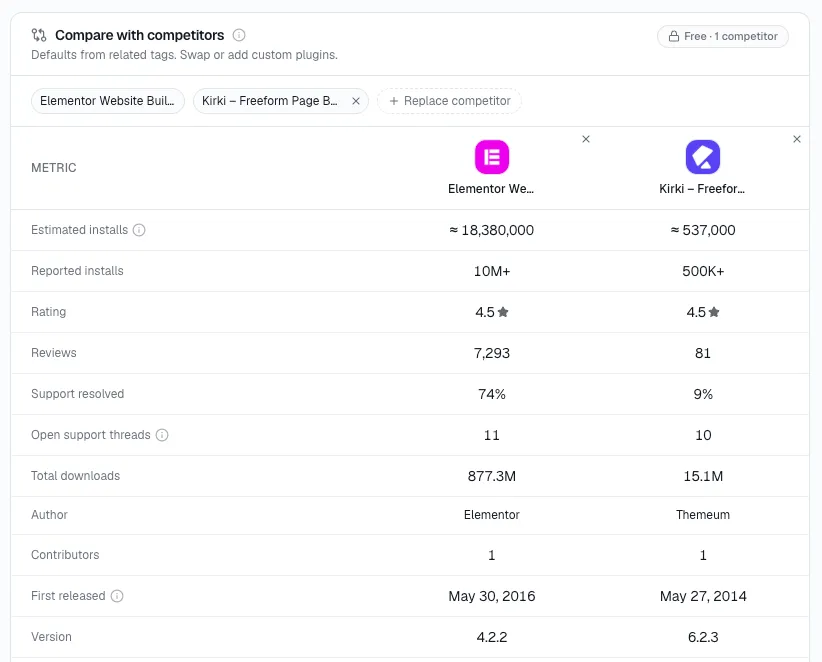
Direct answer: To benchmark your WordPress plugin against competitors, run your own plugin through the same 11-signal scorecard you'd use on them, pulled on the same day - not against a competitor snapshot you checked weeks ago.
How this differs from just knowing which metrics matter
Knowing that momentum matters more than a raw install count, or that a rating average needs to be read alongside review recency, is general metrics literacy - the kind covered in comparing plugins beyond ratings and installs. Benchmarking is that same literacy applied to a specific question: not "which of these signals matters," but "where do I personally stand against this specific competitor, right now."
The distinction matters because the two exercises answer to different audiences inside your own head. Metrics literacy is what you'd teach someone reading any comparison correctly. A benchmark is what you personally need before deciding what to build, fix, or say next.
I'd call this a narrower, more self-directed exercise, and it only works if both sides of the comparison are pulled at the same moment - which is the whole point of the next section.
Why the same day matters
Installs, growth, and momentum all shift over time, which means a benchmark built from data pulled on different days is comparing two different moments, not two competitors. Pull your own numbers and every tracked competitor's numbers in one sitting, every time you benchmark - the comparison is only meaningful if the clock stopped at the same point for everyone in it.
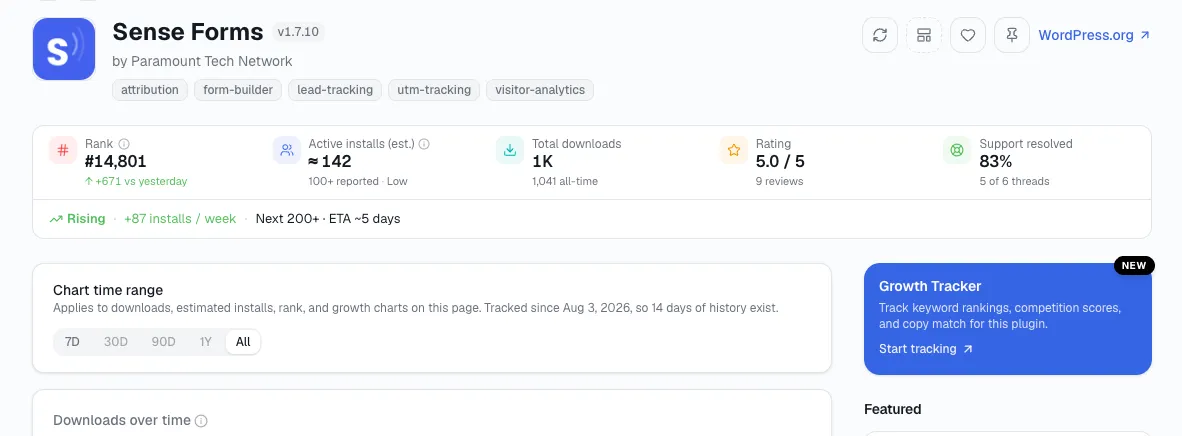
In my view, a benchmark pulled a week apart isn't wrong so much as it's answering a slightly different, less useful question. If your installs are checked today and a competitor's are checked from a note you wrote down two weeks ago, any gap you see could just be two weeks of normal movement on their side - not a real difference between the two of you.
Where you'll actually be ahead or behind
Don't expect to lead on every signal - in my experience, almost nobody does. I've found a useful benchmark usually shows you clearly ahead on two or three signals, clearly behind on two or three, and roughly even on the rest. I score the signals you're behind on as your roadmap; the ones you're ahead on are what your marketing should actually be saying, especially if you're not currently saying it.
Reading your own scorecard as ahead, behind, or even
A same-day pull of five or six signals typically sorts into three buckets. Here's what each one is actually telling you, and what to do next:
| Result | What it means | What to do with it |
|---|---|---|
| Clearly ahead | A real, current advantage on that signal | Say it explicitly in your own marketing if you aren't already |
| Clearly behind | A specific, named gap, not a vague sense of falling short | Add it to your actual roadmap, prioritized by how closable it is |
| Roughly even | Neither side has a meaningful edge on that signal today | Leave it alone for now - not worth spending effort closing a gap that isn't there |
Connecting it to your own growth log
If you're already tracking your own plugin's growth signals, a benchmark is that same log with a competitor's row added next to yours. The value isn't in either log alone - it's in seeing whether a dip in your numbers lines up with a jump in theirs, which a growth log by itself can't show you.
Turning three "behind" signals into one actual priority
I've run into this pattern before: being behind on multiple signals at once is normal, but treating all of them as equally urgent isn't useful. Sort what you're behind on by how closable it actually is, the same way you'd size up a competitor's own strength:
- Behind on something structural - years of accumulated installs, an integration partnership you can't replicate quickly. Note it, but don't put it at the top of this quarter's roadmap.
- Behind on something operational - release cadence, support response time, review recency. These respond to sustained effort within a quarter or two, which makes them the better place to actually spend the next few months.
Running the comparison
Open StatWP's compare tool, add your own plugin - or theme - alongside the competitors you're tracking, and pull the view in one sitting. Every row lands on the same day, so what you're looking at is:
- Where you're ahead - the columns worth saying out loud in your own marketing.
- Where you're behind - your actual roadmap, not a guess.
- Where you're roughly even - not worth spending more time on right now.
That's the entire point of a benchmark that's actually comparable, rather than assembled from whatever tab you happened to check last.
Questions people ask before their first benchmark
How often should I re-run a benchmark against the same competitor?
Roughly the same cadence as your quarterly scorecard refresh - benchmarking monthly won't show much movement, since most of these signals don't shift meaningfully in a few weeks.
What if I don't have enough history to know if a signal is "ahead" or "behind"?
A single same-day pull is still useful even without history - it tells you where you stand today, which is the starting point either way. History mostly helps you tell whether a gap is widening or closing, not whether it exists in the first place.
Should I benchmark against every competitor I track, or just the top one?
Benchmark against your top two or three - benchmarking against every name on a longer tracked list mostly adds noise without changing what you'd actually prioritize next.
What if the same-day pull shows me behind on almost everything?
A same-day pull showing you behind on almost every signal is rare but not a reason to panic or distrust the numbers - it usually means the competitor is simply bigger and further along, not that every gap is equally urgent. Sort what you're behind on by how closable it is before deciding what to act on first, the same way you would with a smaller list of gaps.
Can I benchmark against a competitor I haven't been tracking regularly yet?
You can pull a one-off same-day comparison against anyone, but treat it as a single data point rather than a trend. Without a tracking history behind it, you won't know if today's snapshot is typical for that competitor or an unusual outlier month.
Make the benchmark a habit, not a one-time exercise
A single benchmark answers where you stand today. Run it again next quarter against the same competitors, using the same signals, and you start seeing whether the gaps you flagged as roadmap items are actually closing - or whether a competitor you thought you'd caught up to has pulled ahead again in the meantime.