
Finding a WordPress plugin competitor's real strengths and weaknesses means reading three qualitative sources - their reviews, their stated positioning, and exactly where their feature list gates into a paid tier - because the numeric scorecard tells you how a competitor is performing, not why, or where it's vulnerable. That scorecard already goes past the two numbers most people stop at - see how to compare plugins beyond ratings and installs - but even the full version of it doesn't explain the why; these three qualitative sources do.
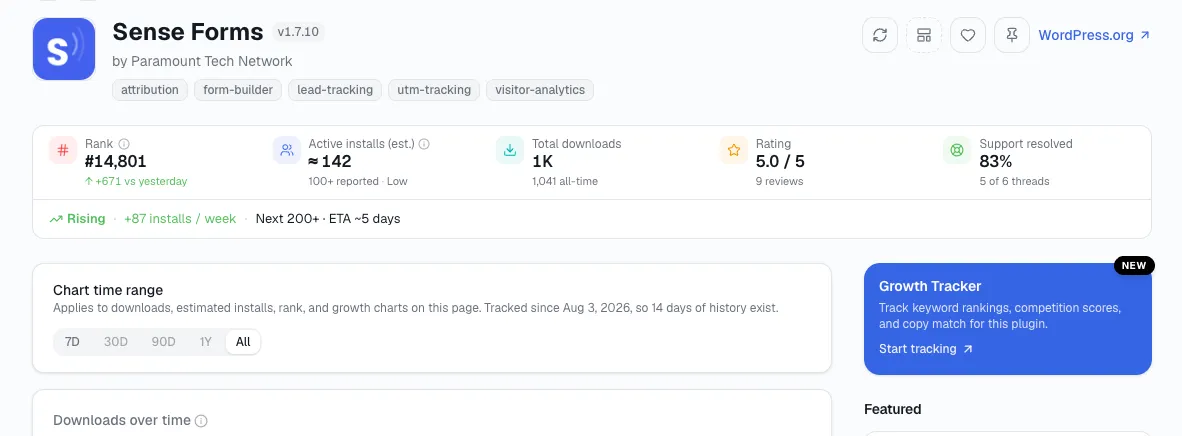
The numeric backdrop for this read is one lookup: search the competitor's name on a StatWP plugin page (or theme page, if that's what they make), and its overview card lists:
- Active installs
- Growth %
- Rating average
The three qualitative sources below are what actually explain the why behind those numbers.
Look Up a Competitor's Numbers
Bottom line: To find a WordPress plugin competitor's real strengths and weaknesses, read their reviews, their stated positioning, and where their feature list gates into a paid tier - the numeric scorecard tells you how they're doing, these three sources tell you why.
What their reviews actually credit and blame
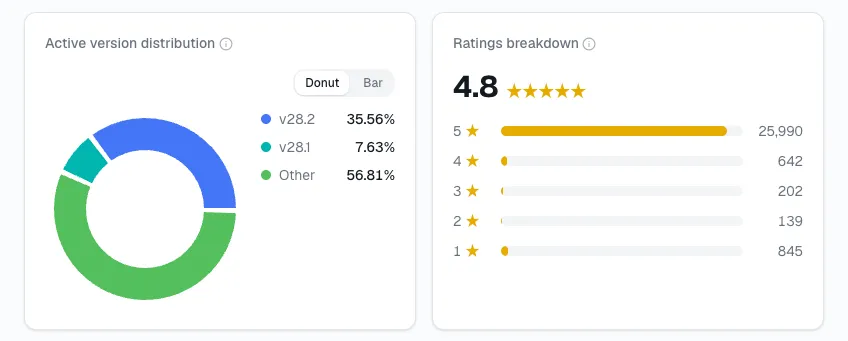
Read the 4- and 5-star reviews for what gets specifically praised, and the 1- and 2-star reviews for what gets specifically blamed - both in the reviewer's own words, not your summary of the sentiment. A strength that shows up unprompted across many reviews is a real, defensible advantage. A weakness that shows up the same way, especially if it repeats across several unrelated reviewers, is a specific, provable gap rather than a guess.
Sort reviews into rough themes as you read rather than treating each one in isolation. If four separate one-star reviews all mention the same specific failure - a setting that doesn't save, a conflict with a common caching plugin, a support ticket that went unanswered for weeks - that's not four isolated complaints, it's one weakness stated four times. Something I've picked up on: a single angry outlier review, on the other hand, is weak evidence on its own.
For a much deeper pass on exactly this step - grouping a competitor's reviews into complaint topics, ranking them by severity, and turning the pattern into an actual feature idea - see how to turn a plugin's bad reviews into your next feature idea, which walks through StatWP's Review Gap Finder for this specific job.
What their positioning avoids saying
Read their marketing copy the way you'd read a pitch you were skeptical of - not for what it says, but for what it carefully doesn't claim. A plugin that markets heavily on ease of setup and says almost nothing about performance at scale is very likely telling you, indirectly, where its actual weakness sits - vendors rarely lead with the thing they're worst at, but they also rarely manage to avoid the topic entirely if it matters to their buyers.
Read their homepage, their WordPress.org listing description, and their pricing page as one set, not separately. A claim that shows up on the homepage but never gets backed up on the pricing or feature page - "enterprise-ready" with no actual enterprise features listed - I flag that as a positioning gap worth noting on its own.
Where their feature list actually gates
Map their features into free, capped, and paid-only, the same way you would when validating a plugin idea - the same approach works whether the competitor is a plugin or a theme. A competitor whose most-requested feature sits behind their highest paid tier has a specific, known weakness for any price-sensitive segment of their market - and that gate is usually visible on their own pricing page, not hidden.
Cross-check the gate against the reviews you already read. If a feature sitting behind their paid tier is also the same thing showing up as a complaint in their free-tier reviews, I put that down as the clearest kind of weakness there is - a documented gap between what a real segment of users wants and what they're actually able to get without paying.
Reading it as strengths versus weaknesses
A quick way to sort what you've found:
| Source | Strength signal | Weakness signal |
|---|---|---|
| Reviews | Same specific praise, repeated across unrelated reviewers | Same specific complaint, repeated across unrelated reviewers |
| Positioning | A claim they back up with real detail | A topic their marketing carefully avoids |
| Feature gating | A key feature free at every tier | A commonly requested feature gated behind their top tier |
Three assumptions worth checking before you trust a read
Myth: a plugin with mostly five-star reviews has no real weaknesses. Check the volume of one- and two-star reviews against the total, not just the average. A 4.7-star plugin with two hundred reviews can still carry a dozen one-star reviews all describing the same unresolved bug - a real weakness the headline average hides.
Myth: whatever a competitor's homepage leads with is their actual biggest strength. Check it against reviews before trusting it. Marketing copy is a claim, not evidence - the strength confirmed by both positioning and unprompted review praise is the one worth taking seriously.
Myth: a feature gated behind a paid tier is automatically a weakness. Check whether users are actually asking for it in reviews first. A gated feature nobody mentions wanting isn't a weakness, it's just a normal pricing decision - the gate only becomes a real vulnerability when it's blocking something a visible segment of users clearly wants.
Combining all three
A strength confirmed by both reviews and positioning is real and worth respecting, not underestimating. I've found a weakness that shows up in reviews but that positioning is visibly working around is your clearest opening - it's a gap the competitor already knows about and hasn't closed. Reverse-engineering their scorecard tells you what's true about their numbers; this is what tells you what to actually do about it.
Common questions on reading a competitor this way
How many reviews do I need to read before a pattern counts as real?
I use three or more reviews from clearly unrelated users as a reasonable bar for calling a complaint or a compliment a real pattern rather than a one-off - there's no official fixed number.
What if a competitor has very few reviews to work from?
With very few reviews to work from, lean more heavily on the competitor's positioning and feature gating, and treat any review-based read as tentative until more reviews accumulate. My honest read: a small review count is worth noting itself - it's a weaker foundation for any claim about broad user sentiment.
Should I read reviews on WordPress.org only, or other sources too?
I start with WordPress.org since it's the most consistent review source across both plugins and themes, but don't stop there if the competitor also sells through their own site or a marketplace - those often carry a different, sometimes more candid, set of reviews.
How is this different from the numeric scorecard I already ran?
StatWP's numeric scorecard tells you a competitor's installs are flat, or their rating average sits at 4.2 - facts about performance. Reading their reviews, positioning, and feature gating tells you why: which specific thing users complain about, which topic their marketing avoids, which feature they've chosen not to give away for free. The scorecard is the what; this qualitative read is the explanation underneath it.
Turn the read into a decision, not just a list
A pile of noted strengths and weaknesses is only useful once it's connected to something you'd actually do differently. For every weakness you find, ask whether it's something your own plugin already handles better, or something worth building toward - a weakness you can't yet address isn't wasted information, it just belongs on a roadmap instead of in this week's marketing copy.